Donate!

Showing posts with label force. Show all posts

Tuesday, May 17, 2016

The Hydrostatic Equation

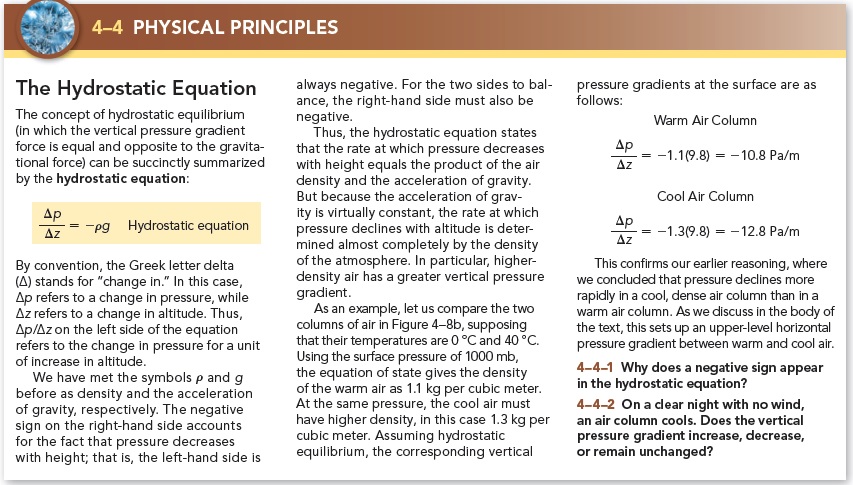
Hydrostatic Equation:

Hydrostatic Balance is when the net upwards force is equal to the downward force, requiring that the balance of forces in the vertical…
The pressure at height, z, is equal to the weight of the air in the vertical column of unit cross-section lying about that level.

Hydrostatic Equilibrium is when vertical pressure gradient force and the force of gravity are normally of nearly equal value and operate in opposite directions when…
     Gravitational force = vertical pressure gradient force in magnitude à no vertical acceleration occurs
     Gravitational force > vertical pressure gradient force à downward motion
     Gravitational force < vertical pressure gradient force à updrafts can develop that are associated with powerful thunderstorms.


Gradient Winds

Gradient Wind (or flow) develops only in the absence of friction, when considering curved flow and flows perpendicular to the contours, for the same reason as in geostrophic flow. However, gradient wind is not truly geostrophic because it is constantly moving, thus undergoing an acceleration. Nonetheless, this time, in order for the air to follow parallel to the contours there must consider the effects of the centrifugal force as well as the pressure gradient force and the Coriolis force.

Subgeostrophic Flow is when V < Vg, air curves cyclonically (counter-clockwise), and the CF needs greater than in the geostrophic case in order to balance the PGF.


Supergeostrophic Flow is when V > Vg, air curves anti-cyclonically (clockwise), and the CF does not need to be as great as in the geostrophic case in order to balance the PGF.

Putting it all together…


Geostrophic Wind (and Equations)

Geostrophic Wind is a nonaccelerating flow occurring only in the upper atmosphere (due to the lack of friction) and when the winds are considered at “steady-state” (when the PGF counterbalances the CF). In fact the geostrophic flow is simply a special case of gradient flow that arises when the wind flows parallel to the isobars.


Conservation of Angular Momentum (Derivation of the Coriolis Force)

Angular Momentum takes into account the rotation of the object. Whereas, the conservation of angular momentum is a law of physics that states the angular momentum of a rotating object (with no outside force) remains constant regardless of changes within the system (i.e. Earth’s rotation Ω). This conservation of angular momentum will always be maintained as long as there is no net external torque acting on the object or on the system itself.

Example: Derive the Coriolis Force.


Thursday, April 28, 2016

Coriolis Force Motion on a Latitudinal Circle

Coriolis Force—the force per unit mass that results from the rotation of the earth and acts on a moving particle with respect to the earth to deviate it.
  •      Perpendicular to the axis of rotation and the velocity vector.
  •      Directed to the right (in the Northern Hemisphere) and radially outward from the axis of rotation. 
  •      Can only change direction, not magnitude.

Components of the Coriolis force (CF) due to relative motion along a latitude circle. Ra is the apparent radius, Re is the radius of the earth., and omega is Earth's rotational frequency.

Wednesday, March 23, 2016

Newton's Three Laws of Motions

            Isaac Newton, the father of mechanics, is one of the most important scientists who ever lived, changing the standards by which scientists think today. His genius in mathematics and mechanics is exemplified by his creation of calculus to explain observations of the world around him. In addition, his laws of motion opened the door to progressive new thinking, enlightening the minds of thousands to the nature of things. His laws of motion make up the foundation for which dynamic meteorology exists.

1)    Law of Inertia—a body at rest or in motion will tend to stay that way until acted upon by a net external force.

2)    Law of Acceleration—a change in motion relates directly to a force trying to move it.
F = ma    or    F = ρg


3)    Action-Reaction Law—for every action there is an equal and opposite reaction.