Donate!

Showing posts with label equation. Show all posts

Tuesday, May 17, 2016

Thermal Wind

            Thermal Wind is the vertical shear of the geostrophic wind cause by a horizontal temperature gradient—it “blows” parallel to the thickness contours, leaving low thickness to the left. The Thermal Wind Equation states that the vertically averaged shear of the geostrophic wind (within the layer between any two pressure surfaces) is related to the horizontal gradient of thickness of the layer, in the same manner in which geostrophic wind is related to geopotential height.
Expressed as a linear relationship between vertical wind shear of the geostrophic wind and the horizontal temperature gradient,
            In a barotropic atmosphere—where density is only a function of pressure—the slope of the isobaric surfaces are independent of temperature thus, the geostrophic wind doesn’t increase with height. In other words, there is a complete absence of the horizontal temperature (thickness) gradients such that on constant pressure surfaces. However, the slope of the isobaric surfaces and the speed of the geostrophic wind may vary from level to level due to those thickness variations.
            In an Equivalent Barotropic Atmosphere, isobars and isotherms, on a horizontal surface map, have the same shape.
            In a Baroclinic Atmosphere—where density is a function of both pressure and temperature—the height and thickness contours intersect such that the geostrophic wind exhibits a component normal to the isotherms (or thickness contours). In other words, the horizontal temperature gradients cause the thickness of the layers between isobaric surfaces to increase with higher temperatures. When multiple layers are stacked on each other the geostrophic wind and the slope of the isobaric surfaces increase with height.


Quasi-Geostrophic (Q-G) Omega Equation

            The Quasi-Geostrophic Approximation assumes, among other things, geostrophic and hydrostatic balance. Noting that advection is overshadowed by the geostrophic contribution, only allowing limited departures from the geostrophic balance, is reason it is not simply geostrophic and, instead, quasi-geostrophic. However, the advection of vorticity and thermal gradients usually disturb the geostrophic and hydrostatic balance, which is where the quasi-geostrophic equation could come in handy. To put it briefly, the Q-G equation, on a hypothetical vertical motion field, restores the geostrophic and hydrostatic balance accurately and instantaneously. In other words, the vertical motion could be considered a response to the disrupting factor of geostrophic advection on a system. Although, more importantly, this should be thought of as a hypothetical scenario due to the fact that there is no physical manifestation thus cannot be measured.
The Quasi-Geostrophic Omega Equation represents a method for diagnosing midlatitude, synoptic-scale vertical motions at a specific time. Neglecting diabatic processes, it implies that vertical motion can be calculated from a series of geopotential height analyses at different pressure levels—it is a diagnostic measure of vertical motion based on geopotential height.

For 3-D laplacian of omega, ω (vertical motion) it is important to remember that the sign of the term is proportional to the negative of ω. It is, also, common to assume the dominance of vertical motion is sinusoidal: approximately zero at both the surface and tropopause, and attaining a max/min value in the mid-troposphere hence, qualitatively, like a minus sign.
The vertical differential of geostrophic absolute vorticity advection term is proportional to the rate of increase of geostrophic absolute vorticity advection with increasing height. Overall, vorticity advection increasing with height forces synoptic-scale upward motion. However, vorticity advection at some pressure (mb) alone does not force the vertical motion, it is the change of vorticity advection with height that does.
The 3-D laplacian of thickness (thermal) advection relates to the laplacian of (horizontal) temperature advection to vertical motion, ω—which are greatest when the gradients of temperature advection are large. The dot product, within the brackets, is proportional to the negative of geostrophic advection of thickness.

Nonetheless, warm air advection also plays a role in the Q-G equation because it will increase the thickness of the layer, resulting in higher heights aloft compared to below. Which implies the formulation of anticyclonic vorticity aloft and cyclonic below. In the absence of vorticity advection there is divergence aloft and convergence below. Which, thanks to the vorticity equation, we know that in order to decrease vorticity there has to be negative vorticity advection or divergence.

Mass Continuity Equation

            The Continuity Equation, applied to the atmosphere, is simply a rendition of the principle of Conservation of Mass, stating that matter can neither be created nor destroyed. Yet implying that, again, for the atmosphere, the [constant] mass may be redistributed. However, air parcels expand and contract as they respond to pressure changes that may alter their volume in one of two ways: those that are associated with sounds waves and those which occur in association with hydrostatic pressure changes; granted that hydrostatic volume changes are only taken into account when the equation is expressed in (x, y, p) coordinates.

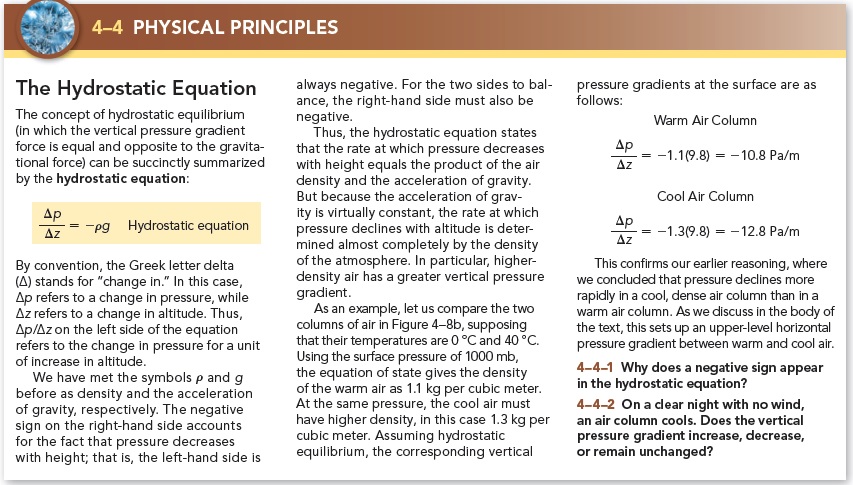
The Hydrostatic Equation

Hydrostatic Equation:

Hydrostatic Balance is when the net upwards force is equal to the downward force, requiring that the balance of forces in the vertical…
The pressure at height, z, is equal to the weight of the air in the vertical column of unit cross-section lying about that level.

Hydrostatic Equilibrium is when vertical pressure gradient force and the force of gravity are normally of nearly equal value and operate in opposite directions when…
     Gravitational force = vertical pressure gradient force in magnitude à no vertical acceleration occurs
     Gravitational force > vertical pressure gradient force à downward motion
     Gravitational force < vertical pressure gradient force à updrafts can develop that are associated with powerful thunderstorms.


Tuesday, March 22, 2016

Ideal Gas Law / Equation of State

The ideal gas law combines Boyle’s law, Charles’ law and uses volume as the inverse of density. All gases are found to approximately follow this equation.


     Gases tend to expand when heated and become denser when cooled.
     Density increase + constant temperature = pressure increase

     Constant density + temperature increase = pressure increase

Deriving the Hypsometric Equation


Deriving Poisson's Equation

In mathematicsPoisson's equation is a partial differential equation of elliptic type with broad utility in electrostaticsmechanical engineering and theoretical physics. It is used, for instance, to describe the potential energy field caused by a given charge or mass density distribution. The equation is named after the French mathematiciangeometer, and physicist Siméon Denis Poisson. [Wikipedia]
Siméon Poisson


Friday, March 18, 2016

Physical Principles: The Hydrostatic Equation

Understanding Weather and Climate (7th Edition) (MasteringMeteorology Series) by Edward AguadoJames E. Burt.


   Hydrostatic Balance = if the net upwards force is equal to the downward force
     For an atmosphere in hydrostatic balance, the balance of forces in the vertical requires that…
   Or, the Hydrostatic Equation:
     The negative sign ensures that the pressure decreases with increasing height
     Because
 we can rearrange the hydrostatic equation to give…

   Above a fixed point on Earth…
     That is, the pressure at height z is equal to the weight of the air in the vertical column of unit cross-sectional are lying about that level.

Hydrostatic Equilibrium
   Pressure gradient force causes wind to flow from high to low pressure
   Air pressure rapidly decreases with altitude
   Gravity pulls all mass, including the atmosphere, downward.
   Hydrostatic Equilibrium = vertical pressure gradient force and the force of gravity are normally of nearly equal value and operate in opposite directions
     When, gravitational force = vertical pressure gradient force in magnitude à no vertical acceleration occurs
     When, gravitational force > vertical pressure gradient force à downward motion
When, gravitational force < vertical pressure gradient force à updrafts can develop that are associated with powerful thunderstorms