|
| Upper level charts for 00 UTC Nov. 10, 1998, showing geopotential height (black contours), temperature (red contours), and observed winds. Contour interval 30 m for 850- and 700-hPa height, 60 m for 150-hPa height, 120 m for 250- and 200-hPa, and 60 m for 100-hPa height. The contour interval for temperature is 4 degrees celsius in the left panels and 2 degrees celsius in the right panels. The shading in the 250-hPa chart are isotachs defining the position of the jet stream. [Wallace and Hobbs 329] |
 |
| Synoptic charts at 00, 09, and 18 UTC Nov 10, 1998. (Left) The 500-hPa height (contours at 60-m intervals; labels in dkm) and relative vorticity (blue shading; scale on color bar in units of 10^(-4) s^(-1)). (Right) Sea-level pressure (contours at 4-hPa intervals) and 1000- to 500-hPa thickness (colored shading: contour interval 60-m; labels in dkm). Surface frontal positions, as defined by a skilled human analyst, are overlaid. [Wallace and Hobbs 315] |
1000-500 mb / SLP Chart
- Includes SLP and 1000-500 mb thickness
- Given distribution of geopotential height on any two pressure surfaces we can determine the distribution of thickness for the intervening layer.
- The "thickness" chart reveals temperature advection through the lower half of the troposphere.
- Frontal location: A cold front is usually placed at the leading edge of the greatest thickness packing (cold air advection) and a warm front is placed at the trailing edge (warm air advection
- 540 line: meaning 5400 meters between the 1000mb and the 500mb level.
- Often used to delineate the rain/snow line with snow expected on the cold side of that line and rain on the warm side (this is a rule of thumb, not a hard fast law)

800-mb Chart (~1,500 m)
- The 850-mb pressure surface is closest to the surface Through examination some differences should be mentioned:
- Solid lines are height contours (gpm).
- Dashed lines are isotherms (ºC).
- Closed lows at surface may appear as troughs @ 850 (in this case the winds stronger than at surface why? Less friction.
- Winds generally more parallel to height contours.
- Tilt of the cold front westward (backward) into the cold air as one goes up from the surface.
- Warm front is more clearly defined and farther poleward at 850.
 |
| [Wallace and Hobbs 329] |
- Warm Air Advection
- Typically the greatest dynamically caused lifting mechanism over the large scale.
- Related to QG Theory.
- To be detailed in Synoptic Meteorology.
700-mb Chart (3,000 m)
- Typically, the trough associated with surface lows are more difficult to identify and are displaced upstream (in this exceptional case, the low is still closed at 700 mb!)
- Further increase in wind speed
- Cold front located even farther west
- Warm front located much farther poleward and coincides with the location of the precipitation reaching ground.
- Frontal zones less clearly defined than at lower levels. (often difficult to detect equator-ward end of cold front).
 |
| [Wallace and Hobbs 329] |
500-mb Chart (~5,000 m)
- Further upstream displacement of troughs.
- Strengthening of winds.
- Sloping of the frontal zones toward the cold air.
- Frontal zones hard to detect but thermal contrasts exist.
 |
| [Wallace and Hobbs 329] |
250-mb Chart (~10,366 m)
- Near the climatological position of the polar jet stream.
- Warmest air (-44ºC) located north of jet stream near the trough (over 4-Corners).
- Little to no advection as you go south.
 |
| [Wallace and Hobbs 329] |
100-mb Chart (~16,000 m)
- Located well above the tropopause and jet stream.
- In stratosphere there is a marked decrease in wind speed when compared to 250-mb.
- Only planetary scale features present at 100 mb (not the synoptic scale).
- Temperature field reverses -- colder air as one goes toward the equator, warmer towards the poles.
 |
| [Wallace and Hobbs 329] |
Three-Stage Model
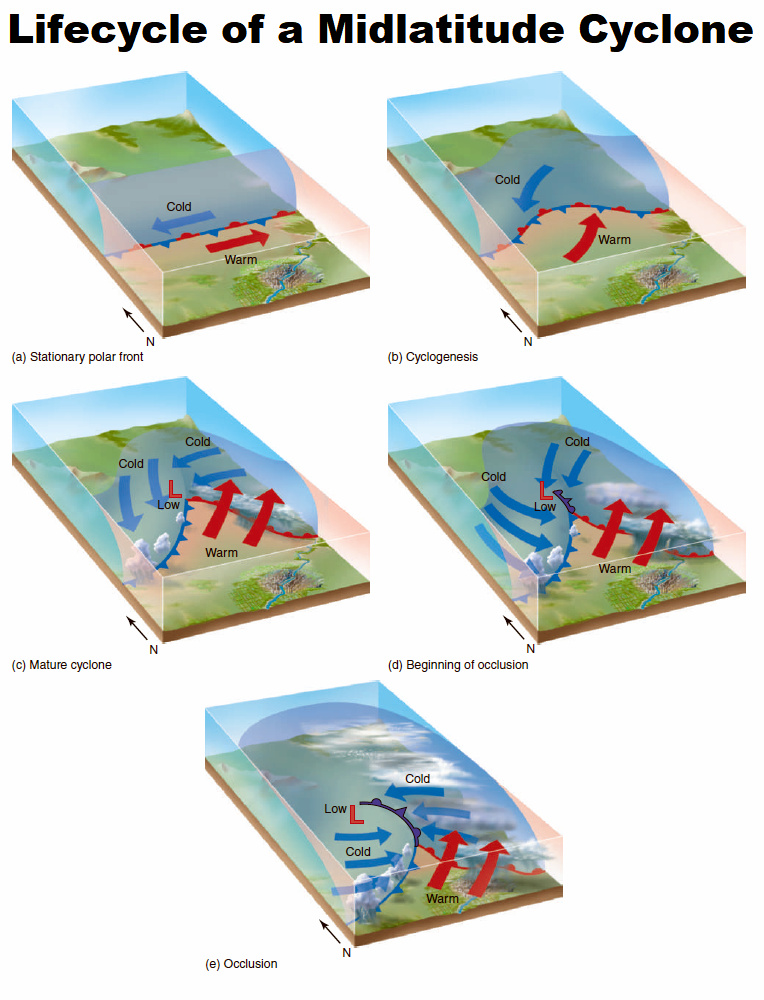
- The three-stage model of an idealized mid-latitude (N.H.) cyclone with 1000-mb heights, 500-mb heights and 1000-500 mb thicknesses shows the development of the cyclone.
- Early Stage - surface low just beginning to form as wave along front on the warm side of the region of strong thickness contrast.
- Mature Stage - cold air starts streaming southward behind the surface low pressure area and warm air advances northward in advance of the cyclone.
- These distortions in the temp. field are reflected in the growing amplitude of the wave in the thickness pattern.The thickness pattern is closely related to the position of the warm and cold fronts.
- Surface low is in the process of passing under the jet stream, from the warm to cold side.
- Late Stage - the occlusion process has begun:
- The surface low moves across the thickness contours towards lower values as it deepens progressively farther back into the cold air.
- Junction of the warm and cold fronts remains on the warm side of the region of strong thickness contrast
- Occluded front coincides with a warm ridge in the thickness field.
- As the disturbance continues to amplify, the positions of the surface low and the 500-mb trough (or closed low) gradually begin to come into vertical alignment (stacked).
- In fully developed systems the vertical tilt completely disappears and all three sets of contours become mutually parallel.
 |
| (Top) Fields of 500-hPa height (thick black contours), 1000-hPa height (thin black contours), and 1000- to 500-hPa thickness (dashed red) at 00, 09, and 18 UTC Nov 10, 1998; contour interval 60-m for all three fields. Arrows indicate the sense of the geostrophic wind. (Bottom) Idealized depictions for a baroclinic wave and its attendant tropical extratropical cyclone its early (left), developing (center), and mature (right) stages. [Wallace and Hobbs 317] |
Vertical Soundings
- Vertical soundings (found through radiosondes) show how the temp changes vertically with height, generally up to 100-mb or so.
- Backing -- counterclockwise winds; CAA.
- Veering -- clockwise winds; WAA.
 |
| Soundings of wind, temperature (red lines), and dew point (green lines) at 00 UTC Nov. 10, 1998 at Amarillo, Texas (left) in the cold frontal zone and Davenport, Iowa (right) in the warm frontal zone. [Wallace and Hobbs 331] |
 |
| Sea-level pressure, surface winds, and frontal positions at 00, 09, and 18 UTC Nov. 10, 1998. Frontal symbols and wind symbols are plotted. The dashed blue line denotes the secondary cold front. The frontal positions are defined by a human analyst. [Wallace and Hobbs 319] |
Vertical Cross Sections
- It is important to know the vertical structure of the atmosphere near a cold front.
- The forthcoming cross section was constructed using temps and wind soundings at locations between Riverton, WY, and Lake Charles, LA.
- Temps in ºC are solid red lines.
- Solid blue lines are isotachs (lines of constant wind speed) for the wind component normal to the section (positive into the section, negative out of the section).
- The section is oriented normal to the front and to the jet stream.
 |
| [Wallace and Hobbs 329] |
 |
| Locations of the stations and vertical cross sections shown in this section. From north to south, KMQT is the station identifier for Marquette, Michigan; KRIW for Riverton, Wyoming; KLBF for North Platte, Nebraska; KSUX for Sioux Falls, South Dakota; KGAG for Gage, Oklahoma; KSGF for Springfield, Missouri; KBWG for Bowling Green, Kentucky; KCAE for Columbia, South Carolina; KJAN for Jackson, Mississippi; and KLCH for Lake Charles, Louisiana. [Wallace and Hobbs 339] |
 |
| Screen capture from a PDF version of a powerpoint. Images from Wallace and Hobbs 319, 333, and 339. |
Characteristics of Cross Section
- Well defined frontal zone in the lower troposphere, sloping toward the cold air with increasing height.
- Within the frontal zone the isotachs are sloping and very close together, wind component into the section is increasing very rapidly with height. This represents an area of strong vertical wind shear.
- Middle-latitude tropospheric jet stream is located within the gap in the tropopause where winds are the greatest (80 m/s)
- Reversal in the horizontal temp gradient between troposphere and stratosphere.
Isentropic Analysis
- Sometimes we use potential temp rather than temp in these cross section analysis. We like isentropic analysis because:
- Under adiabatic conditions the isentropes in sections can be closely identified with air motion.
- In the figure the stability stratification is directly related to the vertical spacing of the isentropes.
- Regions of close spacing (i.e. the stratosphere and frontal zone) are characterized by strong static stability.
 |
| Screen capture from a PDF version of a powerpoint. Images from Wallace and Hobbs 319, 333, and 339. |
Upper-Level Structure
- Understanding how cyclonic disturbances change over time requires a keen understanding of cyclones at various heights within the entire troposphere.
- Often we think of 500-mb winds as steering winds for features at the surface.
- The upper level patterns also act to influence the rates of intensification and weakening of surface cyclones and anticyclones, as well as the amounts of precip. associated with them.

Convergence and Divergence in a Column
- Convergence (divergence) within an air column is associated with increasing (decreasing) surface pressure, since the weight of the air column will increase (decrease) with time.
- Vertical motions in the atmosphere are related to divergence and convergence fields.
 |
| The relationship between divergence, convergence, and vertical motions in air columns. Black portions of arrows are outside the columns, while gray portions are inside. [Robert et al. 139] |
Works Cited
Rauber, Robert M., et al. Severe and Hazardous Weather: An Introduction to High Impact Meteorology. 4th ed., Kendall Hunt, 2014.
Wallace, John, and Peter Hobbs. Atmospheric Science: An Introductory Survey. 2nd ed., Academic Press, 2006.